
Every Kindness Is Saving a Life
At the start of Mark 3, we find Jesus speaking to his distractors, and this time he brings up Sabbath. Here he's back in the synagogue on the Sabbath and in the congregation there's a man with a "shriveled hand", and Jesus asked his detractors this time, which is lawful on the Sabbath to do good or to do evil, to save a life or to kill. But they remained silent. Now, the reason they remain silent is they know what Jesus is going to do, right, but also because Jesus is referring here to a particular teaching of the Pharisees.
New Wine and Old Wineskins: When It's Time to Begin Again
When people try to pit Jesus against the Pharisees, his basic first response is, "well, that's their thing, this is mine." And sure, of course, later Jesus will go after. He will critique particularly those people who he sees wielding power over and against the common people, but generally, as a mission statement for his life, he is not all that enamored with tearing things down, at least not in the way that he's committed to building something new.
When Demons Have Names: Legion and the Layers of Our Separation
There's a neat example in Mark 5 of what I call an enacted parable. An interaction that Jesus is using to speak to something larger. However, part of the symbolism in this parable only becomes clear when looking several decades into the future. So we have two options: 1. Jesus is enacting the parable prophetically or 2. The writer is looking back creatively.
Jesus and the Pharisees: A Misunderstood Relationship
We sometimes have this imagination that the Pharisees were harsh and therefore hated by the people, as opposed to Jesus, who was loved by all the common folk. The truth, however, is more nuanced, and the Pharisees were largely considered the liberals of the day, and that made them quite popular. For example, from inter-Testamental Jewish writings that we know of, the Pharisees were often the group that downplayed religious punishment and were most often criticized for being too lenient with religious penalty.
The Parables We Live
When scholars look at tightly packed similar stories like we find in the opening of Mark, they will often refer to them as symbolic actions. And that's a tricky phrase, because often people will hear that and latch on to the word symbolic and then assume that what scholars are trying to do is undermine the historicity of these miracles, like they didn't really happen. They're just symbols or metaphors. Personally, I don't think that's really all that scary. To be honest, sometimes the line between what's a parable and what's not from Jesus is nuanced.

A New Language for Distress
Right near the start of Mark there is a series of healing narratives. In one of them Jesus heals "the demonized." And, interestingly, this is the only story of the four where we actually see the specific term healed or therapeou appear. And therapeou is actually the least magical explanation for what happens in the story. therapeou is where we get the English word therapy from and that's because in Greek it referred not to the work of healers but to the work of doctors. Now, to use the word doctors in this context is, of course, an anachronism, but in the ancient world, therapeou was used to describe the application of a salve to heal a wound or a plaster cast to heal a broken bone. The primary sense was to care for or to wait upon someone. Medically. Theropuho is not a magical term, it's a therapeutic term. It implies a long, slow process of healing.
The Social Location of Healing
In the final story of Mark's opening healing sequence, a group of men want their friend made whole, and so does Jesus, but that starts with the stigma that sets him apart from everyone else. Healing is more than the fixing of bones, it is the repair of all that pulls us apart and makes us think we are separate. A woman is healed so she can join the party. The demonized are calmed so they can be seen as neighbors again. A man excluded by leprosy is reintegrated into society. Now, the stigma of sin rooted in a misunderstanding of what health means is wiped clean for those watching. And if that social location of kingdom can slowly take root in our hearts, if we can repent and believe that good news for ourselves and for those near us, then perhaps, as Jesus says, we actually can do greater things than these.
Returning to Ourselves
When you are spiralling and making bad choices, more negative self-talk is rarely the answer. Often, it’s slowing down, stopping even, reflecting on the narratives you tell yourself about yourself so that you can find a better place to move forward from. What we name as sins are the symptoms of not knowing yourself the way God knows you.

The Divine Warrior Reimagined
Revelation uses this very popular first century literary genre called apocalypse, specifically to upend a lot of our violent fantasies about God. In Revelation 19 John uses an image from Isaiah and he flips it upside down in order completely change the meaning of Scripture. Everything is new in the light of Jesus.
When God Gets Angry: Distinguishing Divine Wrath from Human Reaction
James says that our human anger does not produce the righteousness God desires. So, what exactly is the difference between "human" and "holy" anger. I think it's precision, but I'd love to hear your thoughts.
Rethinking Sexual Ethics Through Wisdom
The truth is we don’t subscribe to the specifics of Paul’s sexual ethic today—at all. Paul has some good stuff to say about marriage. In 1 Corinthians 7 he talks about how we use our bodies and sexuality mutually. Really progressive stuff in the first century.
Who Makes the Rules for God?
For many who are most familiar with evangelical expressions of Christianity, Penal Substitutionary Atonement (or PSA) is the only way they have heard the idea of the cross articulated. Like all metaphors, however, this law court image breaks if stretched too far.

Can We Really Say God is Love?
In a recent video, I claimed that the foundational nature of God, above all other descriptors, is love. So in this video, let's talk about where that claim comes from by looking at the concept of the Trinity and then a very brief introduction to Process Theology and thought.

Rethinking Original Sin: A Better Story for Humanity
The framework for original sin that most of us are familiar with comes from a bad interpretation of a bad translation of one verse in one letter from Pual. Unfortunately, however, it has all kinds of implications for we think about ourselves and God. So let's talk about it.

Expanding Imagination Of God
As people deconstruct and reconstruct their faith in more progressive ways there are a few questions that keep coming up. They tend to be variations on three commons themes.
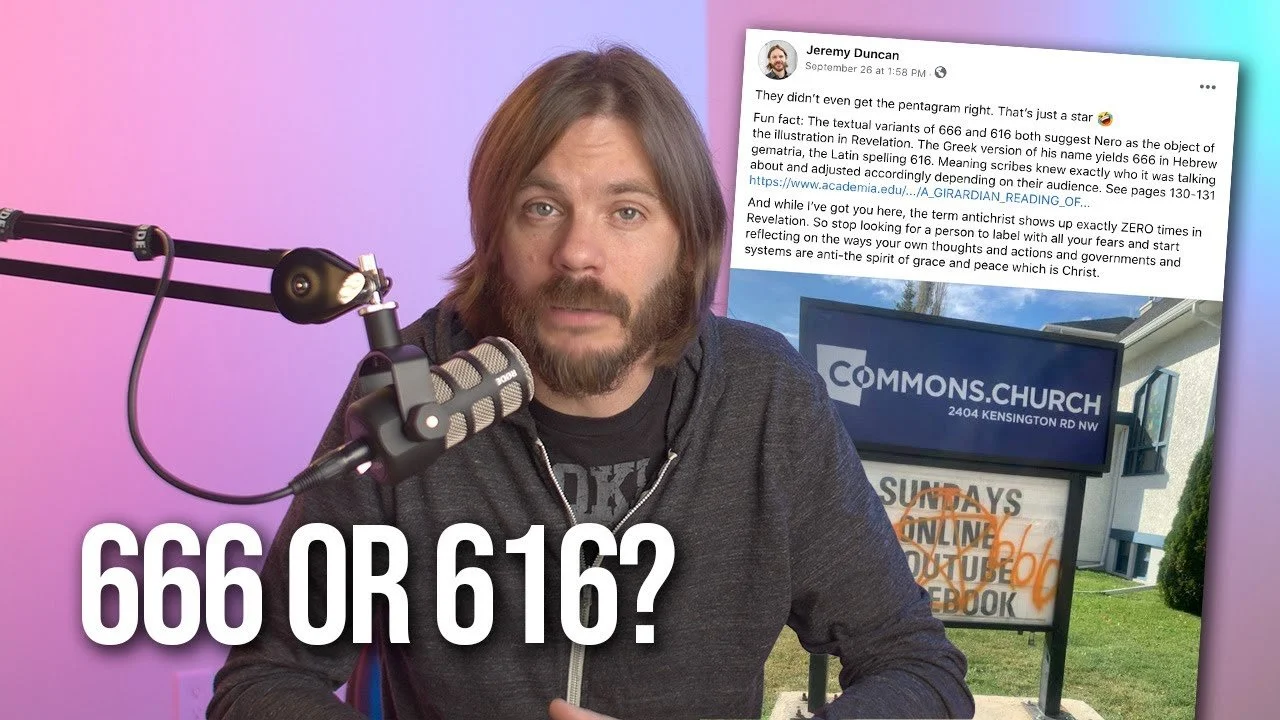
When Graffiti Sparks Theology: Understanding 666 and the Antichrist
The church was vandalized a few weeks ago which was unfortunate but it did give us a good reason to talk about where our popular fascination with the number 666 comes from and why we should all stop worrying about the Antichrist.
Living on the Margins: A Fresh Look at Romans 13
There is a long and terrible history of Romans 13 being weaponized by those in power against the marginalized. The problem, of course, is that this letter was written not to the powerful at all but instead to a community living in the shadow of a hostile authority.
Swipe Right: When Desire Turns Dangerous
We often hear Jesus' teachings on sexuality and assume he was against desire but that approach fragments our humanity and sets up unreasonable expectations. A better way to understand Jesus' teaching is to hear his caution not against sexual desire but against the dehumanizing of another human being into an object to be used.
Who’s Around Your Table?Gratitude, Romans, and a New Chapter in Our Family
In Romans 16 Paul names a number of women in prominent roles within the early church. But then in his letters to Corinth and Timothy, he seems to take a different tone. What is going on here? Should we try to harmonize these passages?
Salvation Without Fear: Rethinking the Story of Legion
The gospels contain a few uncomfortable stories of demon possession. How do we read these stories as modern audiences? Should we accept them at a surface level? Do we chalk them up to ancient misunderstandings of mental health issues? Or can we explore to uncover the sophistication of ancient storytelling and look for the parables hidden in these texts?